
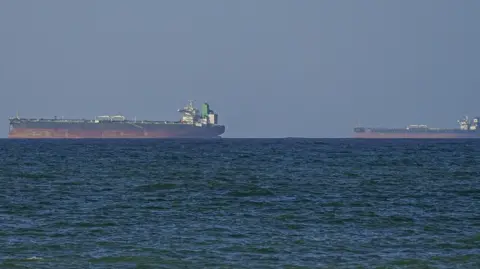
Iran's navy said it has seized two cargo ships in the Strait of Hormuz and taken them to the country's coast after reports that three vessels came under fire from Iranian forces.
Nour News, a website affiliated with Iran's Supreme National Security Council, said the Islamic Revolutionary Guard Corps (IRGC) opened fire on the first ship, the Epaminodes, after it had "ignored the warnings of the Iranian armed forces".
A second ship, named Euphoria, was then stopped after being "fired upon", followed by the targeting of a third vessel, the MSC-Francesca, according to BBC Verify.
IRGC-affiliated outlet Fars News Agency said the Revolutionary Guard was behind the attacks.
IRGC Naval Command posted on social media that the two seized ships - the Epaminodes and MSC-Francesca - had "endangered maritime security by operating without the necessary permits and tampering with navigation systems".
"Disruption of order and safety in the Strait of Hormuz is our red line," the statement read.
The two seized vessels will have their cargo and documents examined, it added in an announcement reported by Iranian state television and warned that the navy is "monitoring" movements through the strait and vowed "firm" action against the "violators".
The statement does not mention the ship Euphoria.
The captured vessels appear to have been part of a larger convoy belonging to the world's biggest shipping company, MSC, which had been in the Persian Gulf since before the conflict began.
Four other vessels in the convoy have since crossed the strait, according to maritime data from Linerlytica. They appear to have turned off their transponders, which share a ship's location, during the passage.
The interceptions come hours after US President Donald Trump extended a two-week ceasefire with Iran until talks between the two nations come to a conclusion.
The initial truce between the US and Iran was due to expire on Wednesday, but Trump said he had been asked to hold off on attacking Iran by Pakistan, which has been acting as a mediator.
Trump, who said a US blockade of Iran's ports would continue, also said the Islamic republic was "collapsing financially" due to the blockade of Hormuz.
Although Iran's lead negotiator is yet to comment on Trump's truce extension, Mahdi Mohammadi - an adviser to the Iranian parliament speaker - said the move by the US president is "certainly a ploy to buy time for a surprise strike".
In a post in Persian on X, Mohammadi said the continuation of Trump's "siege" is "no different from bombardment" and must be "met with a military response". He added: "The time for Iran to take the initiative has come."
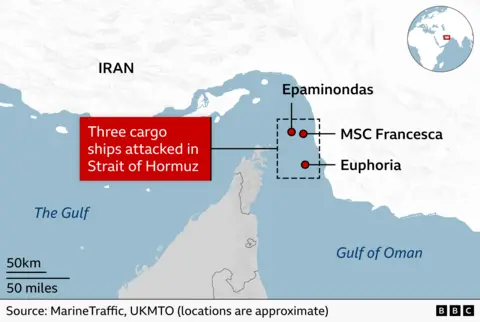
BBC Verify understands that the first ship targeted by the IRGC on Wednesday morning is called the Epaminondas.
The vessel is owned by a Greek company and, according to AIS data from Marine Traffic, was not transmitting a detectable signal while crossing the strait.
Reports from both UKMTO and Vanguard indicate that the ship's master had been told the vessel had permission to transit the strait.
However, it was approached by an IRGC gunboat, which opened fire and caused significant damage to the bridge.
BBC Verify also understands the second cargo ship targeted in the strait is the Panama-flagged Euphoria. It is owned by a UAE-based company and data shows that Jeddah in Saudi Arabia is listed as its destination.
It is not clear who targeted the second vessel. In a statement, UKMTO said it "is aware of high levels of activity in the SoH [Strait of Hormuz] area and encourages vessels to report any suspicious activity".
Later on Wednesday, a third cargo ship - Panama-flagged MSC Francesca - was targeted about six nautical miles off the coast of Iran while it was heading south out of the strait and into the Gulf of Oman.
Maritime intelligence firm Vanguard told BBC Verify MSC Francesca was hailed by the IRGC and "instructed to drop anchor". The ship has reported "damage to the hull and accommodation".
The initial two-week ceasefire brought some respite to the Middle East region, which had been engulfed for weeks in war since the US and Israel attacked Iran on 28 February.
On 8 April, Iran and the US agreed to the conditional truce. Initially, Trump said the deal was struck on the condition that Iran reopens the Strait of Hormuz, a vital shipping route for oil and other exports from the Gulf.
Iran agreed to allow vessels through the strait for two weeks, with their passage coordinated by the Iranian military.
On 13 April, the US then started a naval blockade of maritime traffic entering and leaving Iranian ports. Trump announced the blockade less than a day after lengthy talks between the US and Iran in Pakistan failed to reach a deal.
Under the terms of the US blockade, American forces said they would intercept or turn back vessels travelling to or from Iran's coast, regardless of nationality. The US hoped to put pressure on Iran by restricting its ability to profit from oil exports.
However, with no concrete agreement for a peace deal yet in place, uncertainty has remained and brought little relief to global markets.
Iran's foreign ministry earlier told the BBC that Tehran had still not decided whether it will attend a new round of peace talks with the US.